 |
| George C. Clark at the National Veterans Art Museum today with his painting Showers Photo by Pat Clark
I went to the National Veterans Art Museum today to see the exhibition of prints by Kurt Vonnegut and found one of my "A Year in the Tropics" paintings from the museum's permanent collection also on display.
|
Friday, January 27, 2017
ONE OF MY "A YEAR IN THE TROPICS" PAINTINGS CURRENTLY ON VIEW AT THE NATIONAL VETERANS ART MUSEUM

Thursday, January 5, 2017
SEE MY INTERVIEW ON PBS STATION WTTW CHANNEL !!
 |
| WTTW producer Marc Vitali interviews George C. Clark at the Chicago Cultural Center
I was interviewed recently by WTTW Channel 11 about my current exhibition PORTRAITS REAL & IMAGINARY BY GEORGE C. CLARK at the Chicago CulturalCenter. A few images from my "A Year in the Tropics" Vietnam War series were also shown. Here is a link to the interview.
|
Tuesday, October 25, 2016
A YEAR IN THE TROPICS POSTER ART AT DANON GALLERY IN EVANSTON, ILLINOIS
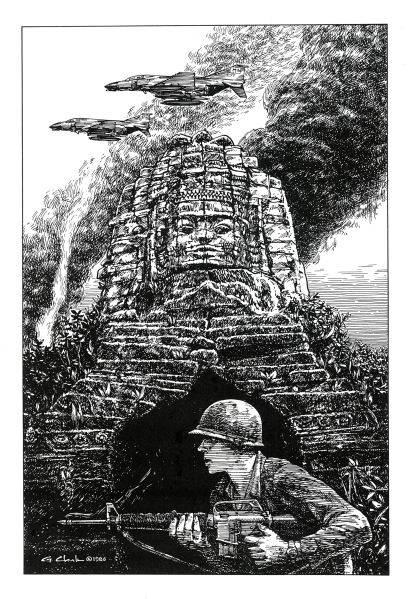 |
| A Year in the Tropics Poster Art, 13.5 x 9 inch ink drawing by George C. Clark
The first exhibitions of my Vietnam War art were at the Evanston Art Center Co-op Gallery and the State of Illinois Building in downtown Chicago (since renamed the Thompson Center). For both venues I had to produce my own announcement cards and posters. Because color printing was prohibitively expensive in those days, I created this poster art for black-and-white reproduction. I wanted it really dramatic, suggesting war in Asia, combat, and showing Air Force planes in action (which would make the image suitable for inclusion in the United States Air Force Art Collection), rather than illustrating a particular incident from my own Vietnam experience. I did see Phantoms rocketing VC targets, but not from as close up as this drawing suggests, and I was in combat, but at an isolated fire support base near the Cambodian border rather than among any of the ancient Khmer ruins in the area.
I had made this drawing on illustration board that isn't ideal for watercolor, so I made a same-size silkscreen print of of it on heavy archival watercolor board and hand-colored that version with watercolor and gouache. That color painting, titled Phantoms in Close Support, is the one that was in my A Year in the Tropics exhibitions and is now in the U.S. Air Force Art Collection. You can see it posted elsewhere on this blog.
So I still have this original ink drawing, and it can currently be seen at Danon Gallery, 1810 Central Street in Evanston, Illinois, where I am having an exhibition with Mark McMahon and John Downs, two other artists who also have work in the U.S.A.F. Art Collection. We are all showing landscapes on the gallery walls, but Bob Danon asked me to bring in a few of my pieces from A Year in the Tropics unframed, and they are displayed on a table at the back of the gallery's front room. The show will be up until about November 10, 2016. Call (847) 899-7758 for gallery hours.
|
Friday, July 22, 2016
A NOTE OF APOLOGY
 |
| When I originally posted this blog I was able to make the pictures any size on the menu and the texts under them stayed the "normal" size I had selected for texts. I just now reviewed the blog and was alarmed to discover that under the horizontal images I had posted "extra large" the texts had also gotten extra wide and the last few words on each line of text had disappeared. I fixed this by reducing the "extra large" horizontal pictures to "large" and now all the texts are legible again. I apologize to anyone who visited this blog in recent months and found parts of it unreadable. Sorry about that. |
Saturday, May 25, 2013
GEORGE C. CLARK GALLERY TALK AT NATIONAL VETERANS ART MUSEUM MAY 25, 2013


I was very honored to be one of the exhibiting artists invited to give a talk about my Vietnam War art at the opening reception of the "Tenacity and Truth" exhibition at the National Veterans Art Museum in Chicago today. My thanks to the Museum's curators and staff, and to all the people who came out to the opening.
Thursday, May 23, 2013
A YEAR IN THE TROPICS drawing included in new exhibition at NATIONAL VETERANS ART MUSEUM
Bad Dog, one of the drawings by George C. Clark from his Vietnam War art series "A Year in the Tropics," is included in TENACITY AND TRUTH: PEOPLE, PLACES AND MEMORIES, a new exhibition featuring art from the Museum's permanent collection at the National Veterans Art Museum, 4041 N. Milwaukee Avenue, Chicago, Illinois 60641. There will be a free and open to the public opening reception for the exhibition on Saturday, May 25, 2013 from 1 to 5pm. George C. Clark will be giving a brief gallery talk about his art and his experiences in Vietnam that afternoon at 1:30pm. The exhibition will be on display at the Museum for about a year.
Sunday, May 27, 2012
A YEAR IN THE TROPICS: An Introduction to the Exhibition
George C. Clark was born in Chicago and earned a BFA degree at the School of the Art Institute there. He was drafted in 1968 and sent to Field Artillery School at Fort Sill, Oklahoma. He watched the 1968 election results in the U.S.O. Lounge at San Francisco International Airport en route to Vietnam. Clark was assigned to Bravo Battery of the 6th Battalion, 27th Artillery, a Second Field Force heavy artillery unit dug in at Song Be Airstrip near the town of Phuoc Binh, the capital of Phuoc Long Province in the highlands along the Cambodian border north of Saigon.
“Bravo Battery’s compound was rectangular,” says Clark, “about the size of two football fields, surrounded by an earthwork with guard bunkers and lots of barbed wire. Our mess hall was the only above-ground structure. All our working and sleeping quarters were in underground bunkers because we were frequently shelled by mortars and rockets. There were 130 men at Bravo Battery, two 175mm cannons, two 8-inch howitzers, and four truck-mounted Quad-50 anti-aircraft guns for perimeter defense.”
Clark served 13 months with Bravo Battery, working in the fire direction center, and was made section chief with a rank of Spec/5 before his discharge in December, 1969. Like a lot of veterans, Clark was glad to put his military experiences far behind him on his return to civilian life. Then, in 1985, he was invited to take part in an exhibition of art by Vietnam veterans at Skokie Public Library. He did one Vietnam painting, then another, and wound up showing four paintings at the Library. “Once I started,” says Clark, “it was as though a floodgate of memories and impressions had opened, and I knew I had to continue the series. Vietnam was a surreal world: I experienced horror and good times, boredom and anxiety, saw acts of savagery and selfless gallantry. I hope through my art to communicate some of this to the people who weren’t there, and maybe strike a responsive chord in those who were.”
After his discharge from the Army, Clark worked in graphic design before his first one-person gallery show in 1978. Since then his landscapes, figure paintings and graphics have been exhibited at many Midwestern museums and galleries and have been awarded prizes by the Art Institute of Chicago, Evanston Art Center, the Artists Guild of Chicago, the Municipal Art League, Rockford College, Beverly Art Center, the Lexington (Kentucky) Art League, and the Rockford Art Museum.
Work by Clark is represented in the collections of the United States Air Force, the National Veterans Art Museum, the Illinois State Museums, the John H. Vanderpoel Art Museum, the Kinsey Institute in Bloomington, Indiana, the Sheraton Station Square Hotel in Pittsburgh, KPMG Corporate Headquarters in Chicago, the Quaker Oats Company in Chicago, McDonald’s Corporation in Oak Brook, Illinois, Sandoz/Novartis AG of Switzerland, Chicago State University Business School Hall of Fame and many other corporate, institutional and private collections located mostly in the Midwest but also in California, Texas, New York, Israel, Japan and England. You can see some of Clark’s paintings and graphics online at his website www.georgecclark.com, his travel art blog travelerssketchbook.blogspot.com, or by image-googling the name George C. Clark.
AN ARTIST IN VIETNAM
 |
| Spec/5 George C. Clark in autumn 1969 Photograph
BY THE TIME I WAS DRAFTED I HAD ALREADY PUT IN A COUPLE OF YEARS AS AN ASSISTANT ART DIRECTOR IN A CHICAGO AD AGENCY, AND HAND LETTERING WAS ONE OF THE THINGS I WAS GOOD AT. AT THE TIME THIS 8 X 8 FOOT SIGN WAS THE LARGEST PAINTING I HAD EVER MADE.
INCIDENTALLY, NO ONE EVER CALLED BRAVO BATTERY "CAMP MARTIN." I HAD BEEN STATIONED THERE OVER NINE MONTHS AND HAD NEVER HEARD THAT NAME UNTIL THE BATTERY COMMANDER ASKED ME TO PAINT IT ON THIS SIGN.
Comment:
At the left of this photo is our mess hall, the only above-ground structure in our compound. The structures you see beyond it are blast walls, tin roofs and the several feet of layered sandbags that topped the bunkers we worked and slept in. The actual bunkers were mostly underground.
|
PHANTOMS IN CLOSE SUPPORT
 |
| Phantoms in Close Support, unique 13.5 x 9 inch silkscreen print from an ink drawing hand colored with watercolor and gouache by George C. Clark U.S. Air Force Art Collection
Comment:
I did the black-and-white ink drawing for this piece to use as poster and announcement art for the first two showings of A Year in the Tropics because color printing was too expensive in 1987. Then I made a silkscreen print of it on archival watercolor board and hand colored it with watercolor and gouache. The color version is now in the U.S. Air Force Art Collection.
I have exercised a bit of artistic license in this painting. I did see our aircraft rocketing targets, but not from as close up as it looks here. And there were Khmer ruins about (I was only a 175mm projectile's throw from Cambodia, after all), but I never saw any of them personally. I have since done archaeology in southern Illinois and Yorkshire, but I didn't have a chance to check out any ruins in Vietnam. I spent over 95% of the thirteen months I was there literally underground in bunkers.
|
THE WORKHORSE
 |
| The Workhorse, 26 x 40 inch acrylic on canvas painting by George C. Clark U.S. Air Force Art Collection
BECAUSE THE ROADS WERE UNSAFE, EVERYTHING WE NEEDED AT BRAVO BATTERY WAS FLOWN IN. THE C-130 WAS THE WORKHORSE OF AIR TRANSPORT IN VIETNAM. IT BROUGHT THE PROJECTILES AND POWDER CHARGES FOR OUR BIG GUNS, AND NEW TUBES (BARRELS) FOR OUR 175MM CANNONS, WHICH HAD TO BE REPLACED EACH TIME THEY HAD FIRED 300 CHARGE 3 ROUNDS. AN OTHERWISE EMPTY C-130 COULD TAKE OFF CARRYING A TUBE FROM THE 2 MILE LONG RUNWAY AT BIEN HOA AND LAND AT SONG BE, BUT THE RUNWAY AT SONG BE WAS TOO SHORT TO TAKE OFF WITH A SPENT TUBE FOR RECYCLING, SO WE DUMPED THE SPENT TUBES OUT ALONG THE RUNWAY. I USED TO WONDER IF THEY WERE STILL THERE, BUT I'M SURE THE VIETNAMESE HAVE LONG SINCE RECYCLED ALL THOSE TONS OF HIGH-GRADE STEEL.
Comment:
I researched this painting when I flew in this plane from Chicago to Rhein-Main Air Base in Germany with an Illinois Air National Guard unit in the 1980s as a guest of the Air Force Art Program. It is a really long flight from Chicago to Germany at about 200 miles per hour. On the way over we stopped to refuel at St. Johns, Newfoundland and Mildenhall RAF in England, and on the way back at Keflavyk, Iceland and Goose Bay, Labrador. The same planes built in the 1950s that I had flown on in Vietnam were still in service. For this painting I showed the plane as it would have looked in 1969 with Vietnam-era camouflage and the tail number of a C-130 I had photographed at Song Be Airstrip.
|
OLD PLANTATION HOUSE
 |
| Old Plantation House, 10 x 14 inch watercolor painting by George C. Clark Collection of the Artist
IF YOU STOOD ON THE BERM (DEFENSIVE EARTHWORK) AROUND BRAVO BATTERY'S COMPOUND, YOU COULD SEE THIS BUILDING A LITTLE OVER A KILOMETER AWAY DOWN THE ROAD TOWARD PHUOC BINH. BEFORE THE WAR, THE HIGHLANDS AROUND HERE HAD ALL BEEN RUBBER PLANTATIONS. NOW WHEN SHELLS EXPLODED IN THE FOREST THE TREES BLED LATEX THAT NO ONE HARVESTED.
Comment:
This is one of the first Vietnam paintings I did, for the 1985 exhibition at Skokie Public Library.
|
CAMBODIAN MERCENARIES
 |
| Cambodian Mercenaries, 10 x 6 inch ink and watercolor painting by George C. Clark Collection of the Artist
I HAD ONLY BEEN IN COUNTRY A SHORT TIME WHEN A COUPLE HUNDRED OF THESE CAMBODIAN MERCENARIES LED BY AMERICAN "SPOOKS" IN UNMARKED UNIFORMS CAMPED OUT OVERNIGHT ACROSS THE AIRSTRIP FROM US. WE WERE NEVER TOLD WHERE THEY WENT OR WHAT THEIR MISSION WAS, BUT A WEEK LATER THEIR CASUALTIES CAME BACK SLUNG UNDER HELICOPTERS IN CARGO NETS. THOSE WERE THE FIRST DEAD BODIES I SAW IN VIETNAM.
Comment:
One of the American "spooks" visited the fire direction center and had coffee with us. When someone asked him where they were heading, he replied (I swear this is true and the first time I ever heard this line), "I could tell you, but then I'd have to kill you." Is it possible that was an actual C.I.A. joke before it became a TV sitcom joke?
|
BAR
 |
| Bar, 10 x 8 inch ink and colored pencil painting by George C. Clark National Veterans Art Museum Collection
Comment:
I saw bars like this in Saigon, but I didn't spend much time in Saigon because the few times I was there I was on my way to more interesting places, like Hong Kong, Singapore, and home.
"Sneaky Pete's," the club at the Special Forces compound in Phuoc Binh, had a pretty Vietnamese bartender, but there was no hanky-panky there because the Special Forces guys were very protective of her and she never hesitated to put down any G.I.'s rude suggestion with an insult comic-style rejoinder.
At Bravo Battery, we had an enlisted men's club and an officer's/NCO club where sodapop and open cans of beer could be had for 50 cents. The clubs were open for a couple of hours most evenings. Since the two fire direction crews rotated ten hour shifts around the clock (so that everyone got to work both day and night shifts), it was rare for us to be coming off duty when the club was open. There wasn't supposed to be liquor outside the clubs, but booze was sold at the post exchange at Long Binh where our service battery was located, and where all of us visited from time to time en route to R&Rs and other business. Once when a soldier reported a camera stolen our battery commander made a surprise inspection of everyone's footlockers. I was on duty in the fire direction center when it happened. He couldn't have missed the fifth of Seagram's VO I had in mine, but nothing was ever said about it.
|
Saturday, May 26, 2012
THE YELLOW SUBMARINE
 |
| The Yellow Submarine, 12 x 24 inch ink and watercolor painting by George C. Clark Private Collection
A COUPLE OF NIGHTS EACH WEEK, IF WE WEREN'T ON ALERT OR ENGAGED IN A FIRE MISSION, THEY SHOWED MOVIES AFTER SUPPER IN THE MESS HALL AT BRAVO BATTERY. MY CREW WAS WORKING IN THE FIRE DIRECTION CENTER THE NIGHT THEY SHOWED THE BEATLES' THE YELLOW SUBMARINE AND WE DIDN'T GET OFF DUTY UNTIL 10 O'CLOCK, AFTER THE FILM WAS OVER. WE TALKED THE PROJECTIONIST INTO SHOWING THE MOVIE AGAIN IN OUR SLEEPING HOOCH. THE BUNKER WE LIVED IN WAS A LONG UNDERGROUND TRENCH THE WIDTH OF A BULLDOZER BLADE, LINED WITH TIMBER AND ROOFED OVER WITH HEAVY BEAMS SUPPORTING SEVERAL FEET OF LAYERED SANDBAGS. ABOVE THE SANDBAGS WAS A TIN ROOF TO DEFLECT RAIN AND TO SET OFF INCOMING ROUNDS BEFORE THEY HIT THE SANDBAGS WHERE THEY WOULD DO MORE DAMAGE. STANDARD DOUBLE DECKED ARMY BUNKS LINED BOTH SIDE WALLS, LEAVING A CENTRAL PASSAGE ABOUT 4 FEET WIDE. BOTH FIRE DIRECTION CREWS SHARED THE HOOCH, WORKING 10 HOUR SHIFTS AROUND THE CLOCK, SO THERE WERE USUALLY GUYS SLEEPING THERE EXCEPT AROUND SHIFT CHANGE TIME. THE MOSQUITO NETTING ON THE BUNKS WAS FOR PROTECTION AS MUCH FROM RATS AS FROM INSECTS.
|
BLACK MARKET FLASHLIGHT BATTERIES
 |
| Black Market Flashlight Batteries, 10 x 10 inch ink and watercolor painting by George C. Clark Collection of the Artist
THE ARMY ISSUED BATTERIES FOR FIELD TELEPHONES AND ARMY-ISSUE FLASHLIGHTS, BUT THERE WERE SO MANY PRIVATELY OWNED FLASHLIGHTS AT OUR FIRE SUPPORT BASE THAT THERE WAS ALWAYS A SHORTAGE OF BATTERIES. YOU COULD HAVE BATTERIES MAILED FROM HOME OR HAVE SOMEONE GOING TO LONG BINH BUY SOME FOR YOU AT THE PX THERE, BUT THE FASTEST WAY TO GET SOME WAS TO GO TO THE MARKET IN PHUOC BINH JUST DOWN THE ROAD. FOR AN ISOLATED BACKWATER TOWN, PHUOC BINH HAD A REMARKABLE SELECTION OF BLACK MARKET GOODS AVAILABLE, INCLUDING FRESH ARMY-ISSUE BATTERIES. I ALWAYS WONDERED IF THE STUFF WAS STOLEN LOCALLY OR STOLEN DOWN SOUTH AND FLOWN IN.
|
Sunday, May 13, 2012
THE ROAD TO SINGAPORE
 |
| Burning Fuel Dump, Song Be Airstrip, October, 1969, 22 x 28 inch acrylic on canvas painting by George C. Clark United States Air Force Art Collection
Comment:
I had enjoyed a five day R&R (rest and recreation) visit to Hong Kong in August, but a soldier at Bravo Battery could have a second R&R if he was in his CO's good graces. I had been made crew chief ("chief computer") of one of the two fire direction crews, and was promoted to Spec/5, and I got a second R&R. I couldn't travel with any of my friends from fire direction because we couldn't spare two crew members at the same time, and besides, I was now in an NCO pay grade, and the one form of segregation the Army practiced was segregation by rank. But I could travel with Sgt. Manny S., crew chief on one of our big guns. We both wanted to go to Singapore, and we got orders cut so we could go together.
The first step in going on R&R was to show your orders to the people co-ordinating flight operations on the airstrip right outside our compound, so they could put you on a flight to Bien Hoa Air Base, near Saigon. From there you would take a shuttle to Long Binh, the giant Army Base (home of 30,000 troops) where our battalion's service battery was located. You'd stay there a night or two, do some shopping at the big post exchange, catch a show (live bands and go-go dancers) at an enlisted men's or NCO club, then on the appropriate day you'd report to the civilian airport in Saigon where charter flights to R&R destinations originated.
Manny and I were out on the airstrip bright and early the day we were authorized to leave. After a while we noticed some commotion and saw soldiers trying to put out a fire in a drainage ditch. Normally a drainage ditch would be a good place to douse a cigarette, but in this case helicopter fuel from the nearby AirCav fuel dump had leaked into the ditch. Flames followed the leak and by midmorning the whole dump was burning. A few planes landed, but none was going where we needed to go, and they shut the airstrip down before lunch.
Manny and I got out the next day and had a great time in Singapore, although what happens in Singapore should perhaps best stay in Singapore. For a sense of the time and place I recommend the book Saint Jack by Paul Theroux. I had bought a camera in Hong Kong and took it with me to Singapore. I did this painting for the Air Force Art Collection in 2008 from the black-and-white photos I took at Song Be Airstrip that day.
|
Friday, May 4, 2012
NIGHT ALERT
 |
| 7 x 13 inch ink and watercolor painting by George C. Clark Collection of the Artist
ON A MOONLESS NIGHT YOU COULDN'T SEE ANYTHING BUT DARKNESS FROM THE GUARD BUNKERS ON OUR PERIMETER, SO YOU'D LISTEN HARD AND WAIT FOR THE MORTAR CREW TO POP PARACHUTE FLARES SO YOU COULD SCAN FOR MOVEMENT OR FOR SHAPES THAT DIDN'T BELONG IN THE CLEARED SPACE OUT BEYOND THE WIRE.
Comment: Bravo Battery"s defenses were formidable. The rectangular compound was surrounded by a berm (earthwork) with guard bunkers and many yards of concertina wire. There were outward-facing claymore mines in the wire that could be set off by tripwires or a switch in a bunker. The bunkers were equipped with grenade launchers, 30 caliber light machine guns like the one shown above, and four 50 caliber machine guns. In each corner of the compound was a quad-50 anti-aircraft gun. These were trucks with a turret containing four 50 caliber machine guns mounted on its bed that could swivel up and down and side to side like the turrets on a World War 2 bomber or the turrets on the Millenium Falcon. We also had a mortar that could fire high explosives or parachute flares to illuminate attackers. We all had M-14 or M-16 automatic rifles. Officers and the perimeter defense NCOs also had army-issued sidearms. The motor sergeant and the weather balloon warrant officer had army shotguns. The track mechanic also had his own Garand M-1 carbine, and several other guys had privately owned handguns. In combat no G.I. ever got in trouble for bringing extra guns or ammo to a firefight. |
THE DUST-OFF
 |
| 17 x 11 inch ink and watercolor painting by George C. Clark Collection of the Artist
ON THE NIGHT OF MOTHER'S DAY, 1969, VIET CONG FORCES MADE A GROUND ASSAULT AGAINST BRAVO BATTERY. AT FIRST LIGHT, WITH A FIREFIGHT STILL RAGING, A MEDEVAC PILOT BRAVED A HAIL OF AUTOMATIC WEAPONS FIRE TO LAND HIS HELICOPTER INSIDE OUR COMPOUND TO TAKE OUT THE SERIOUSLY WOUNDED. WE POPPED WHITE SMOKE TO MARK THE ONLY LANDING SITE OPEN ENOUGH TO CLEAR HIS ROTOR BLADES.
Comment:
This painting has been in all the in all the venues where A Year in the Tropics or elements from it have been exhibited. It was one of six paintings from the series in the 2001 exhibition "Stars & Stripes: Art by Veterans of War" at Steppenwolf Theater in Chicago, and was reproduced on the show's announcement. It was one of two of my paintings shown at the Milwaukee Art Museum in 1992 in an exhibition devoted to Midwest members of the United States Air Force Art Program. When I do another one-person exhibition of this series I will probably use this painting as the poster/announcement art. |
KING OF THE HILL
 |
| 11 x 9 inch ink and watercolor painting by George C. Clark Collection of the Artist
WHEN THE FIGHTING WAS OVER, THERE WERE 29 DEAD VC IN OUR WIRE.
|
BAD DOG
 |
| 8 x 6 inch ink drawing by George C. Clark National Veterans Art Museum Collection
A COUPLE OF DAYS AFTER THE MOTHER'S DAY GROUND ATTACK, ONE OF THE DOGS THAT USED TO SCROUNGE AROUND BRAVO BATTERY'S COMPOUND FOR SCRAPS SHOWED UP WITH A HUMAN HAND IT HAD APPARENTLY SCAVENGED OFF THE BATTLEFIELD BEFORE THE VC CASUALTIES WERE BURIED.
Comment: A 50 caliber round is half an inch in diameter. If one hits you in the shoulder, your arm flies off. If one hits your neck, your head comes off. If two or three are laced across your midsection, your torso is cut in half. We saw ample examples of these effects on the VC bodies left in our wire. Blood trails further out showed that the VC had dragged away many more casualties. This drawing was on exhibit at the National Veterans Art Museum in Chicago in the exhibition TENACITY AND TRUTH: PEOPLE, PLACES AND MEMORIES. This show, drawn from works in the Museum's permanent collection, was up for about a year, from about Memorial Day 2013 to Memorial Day 2014. |
Subscribe to:
Posts (Atom)